Stone Grass: Mowing Simulator
- 4.3
- Rating
- 50.00M
- Installs
- Free
- Price

 Analysis by App-foxy
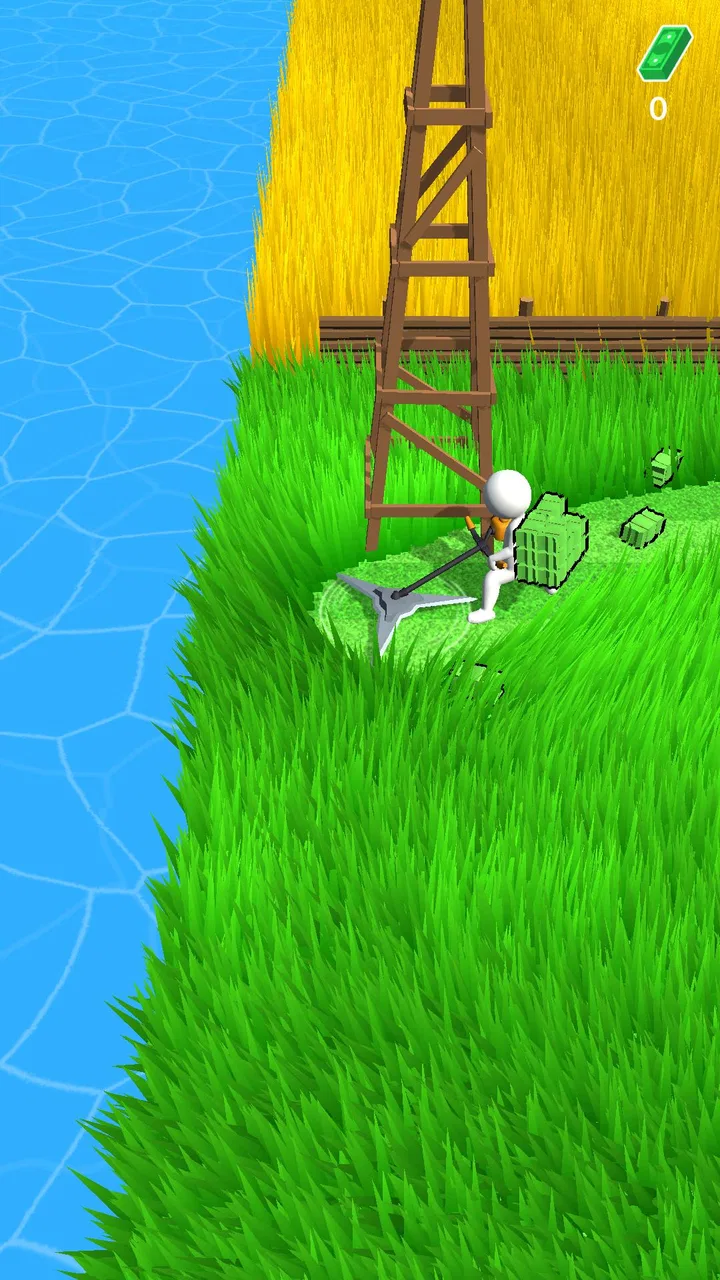
I spent time with Stone Grass: Mowing Simulator as a quick-play arcade game, and my first impression was that its appeal comes from a very simple promise: drive a tractor, cut through grass, gather crops, and keep improving the result. It is easy to understand within moments, but the straightforward idea has enough movement and repetition to make short sessions surprisingly relaxing. I would describe it as a casual mowing game with light harvesting goals rather than a detailed farming simulation.
The game is free to start, carries an Everyone age rating, and comes from Freeplay Inc. It has reached over 50 million installs, with an average score of 4.2 from around 561 thousand ratings. Those numbers suggest that the format has found a broad audience, but they do not change the central question for me: whether the loop stays enjoyable after the novelty of cutting the first few areas disappears.
How the mowing loop feels in everyday play
The basic interaction is immediately approachable. I move the tractor across the field, clear vegetation, collect what is available, and work toward better progress. There is no long tutorial barrier to overcome, so Stone Grass suits the kind of moment when I have only a few minutes and want something that starts quickly. It feels closer to an arcade time-filler than to a game that expects careful planning from the beginning.
You May Also Like

 Blood Strike: 2.5 Anniversary
Blood Strike’s Loadouts Turn Every Drop Into a Tactical Gamble
A close look at Blood Strike’s custom loadouts: how fast access to signature weapons reshapes its battle royale rhythm, rewards preparation, and narrows the gap between fights.

 Pandora - Music & Podcasts
Pandora’s Music Is Easy to Start, but Harder to Recover
Pandora’s strength is its low-effort path from a seed to a station. Its weak spot is how much confidence it asks you to place in connection, setup, and quiet recovery.

 8 Ball Pool
 Is Built on Rivalries, Rematches, and Routine
A close look at the rivalries, rematches, shared routines, and unanswered safety questions that turn a quick pool match into a persistent mobile community.

 Samsung Music
’s Quiet Strength Is Playing What You Already Own
Its reach comes less from spectacle than from dependable access to a personal library. That simplicity is both the app’s strongest retention engine and its ceiling.

 AccuWeather: Weather Radar
AccuWeather Review: A Quick, Clear Forecast for Everyday Decisions
For everyday plans, the best forecast is the one you can understand quickly. AccuWeather makes rain timing, radar, and local conditions easy to act on, with a few trade-offs.

 Hill Climb Racing
Why Hill Climb Racing Still Turns Crashes Into One More Run
A tiny car, a bumpy hill and one more upgrade: Hill Climb Racing keeps resurfacing because its simple chaos makes every near-miss feel personal.
More From Our News Desk



That simplicity is also the reason the game can become repetitive. The satisfaction comes from watching an untidy field become clear and from gradually handling a larger amount of work. If you enjoy visible progress and repeated physical actions, the loop has a pleasant rhythm. If you need a story, varied objectives, or deep farming decisions, the mowing itself may not be enough to hold your attention for long.
I found the best use case to be a short break during an ordinary day. Imagine waiting for an appointment or winding down after work: Stone Grass gives you a task that needs attention but not much mental preparation. I could pick it up, make progress, and stop without feeling that I had abandoned a complicated plan. That makes it more convenient than many traditional farming games, which often ask me to remember several systems before a session feels productive.
Where the pace feels strongest
The perceived speed depends less on racing and more on how quickly the tractor can turn a messy patch into a clean one. Early progress feels brisk because each movement produces an obvious result. I can see where I have worked, and that visual change gives the game momentum even when the underlying activity is repetitive.
Later, the same pace can feel slower if the area to clear becomes broader or if progress requires more repeated passes. This is not necessarily a flaw; it is the natural trade-off of a game built around gradual improvement. The important point is that Stone Grass is not best judged as a high-speed action title. Its speed is comfortable and task-focused, with bursts of satisfying progress rather than constant excitement.
A useful habit is to treat each session as a small route instead of trying to clear everything in one sitting. I get more enjoyment when I focus on finishing one visible section, then decide whether I still want another round. This also makes the repetition feel intentional rather than endless. Players who chase rapid rewards may find the later rhythm less exciting than the opening stages.
What happens during heavier play
The most demanding moments are likely to be the ones where the tractor is working through a larger area and several progress actions are happening close together. From a player’s perspective, these are the moments when responsiveness matters most. I pay attention to whether movement still feels direct, whether the screen remains easy to read, and whether the game lets me understand what has already been cleared.
Stone Grass benefits from keeping its central task visually simple. There is less to mentally track than in a full farming management game, so heavier activity does not automatically become confusing. The trade-off is that the game can feel visually busy when the field, tractor, collected materials, and progress elements compete for attention. On a smaller phone, careful movement becomes more important because a quick swipe or tap can carry more weight than it would on a larger display.
I would not choose this game for a long, uninterrupted session if my main goal were variety. Repeating the same kind of movement for an extended period can make the experience feel like work rather than play. A better approach is to use it in compact bursts, especially when the device is already warm or the battery is low. That is practical advice for any mobile arcade game, but it matters here because the appeal is built around repetition rather than changing scenes or complex encounters.
Another small but useful strategy is to avoid making unnecessary movements. Sweeping back and forth without a clear route can make the tractor feel slower and can reduce the sense of progress. I prefer to make broad, deliberate passes and use the edges of cleared areas as visual markers. This does not transform the game into a strategy title, but it makes the mowing loop feel more controlled and less aimless.
Stability and recovery between sessions
For a casual game, reliability means more than avoiding dramatic problems. I want it to open without fuss, let me resume the activity easily, and make short progress feel worthwhile. Stone Grass is designed around a compact loop, so it has the right shape for interruption. I can play in small windows rather than committing to a long campaign session.
That makes recovery from an interrupted session especially important. If I close the game because my bus arrives or a call comes in, the ideal experience is to return without having to reconstruct a complicated plan. The game’s simple structure works in its favor here: I am generally thinking about the next area to cut rather than a long chain of farming decisions.
Still, I would avoid assuming that every interruption is harmless. Mobile games can behave differently depending on the device, background activity, and available resources. My practical recommendation is to finish a clear piece of work before switching away, particularly if the phone is under pressure from other apps. That way, even if a session ends unexpectedly, the last completed action feels meaningful.
The current version is 1.66.1, which is useful to know when checking compatibility or deciding whether an update is available on your device. The game requires Android 6.0 or later. That minimum makes it accessible to a wide range of Android phones, but compatibility on paper does not guarantee identical performance across every model. Newer hardware should generally offer more breathing room than an older entry-level handset, especially during longer sessions.
Device limits that can change the experience
Stone Grass is an arcade game rather than a technically demanding simulation on paper, but the device still affects comfort. Screen size changes how easily I can judge the tractor’s path. A compact phone is convenient for quick play, yet the field can feel tighter and small interface elements may demand more concentration. On a tablet or larger phone, the same movement is easier to read, although the game may feel less natural to hold during a short break.
Resource demands are also worth considering without turning them into a fixed promise. The game’s repeated field activity may be comfortable on many modern devices, while older phones can be more sensitive to heat, background apps, or limited free memory. If I notice stuttering, delayed input, or unusual battery drain, I would first close other demanding apps, lower the workload on the phone, and restart the game before deciding that the game itself is unsuitable.
I would also keep expectations realistic when playing on budget hardware. The Android requirement allows older operating systems, but operating-system support is only one part of the experience. A phone that technically meets the requirement may still have less headroom for sustained play. Short sessions are the safer choice in that situation, and they match the game’s casual design well.
Storage and data habits matter in a broader sense too. I would install it only when I have enough free space for the game and its normal updates, rather than treating the minimum operating-system requirement as a complete device recommendation. I would also check my connection situation before relying on it during travel, since mobile games can differ in how much they expect from the network even when the actual play feels simple.
Free access, purchases, and the value question
The game is free, which makes it easy to try without an upfront commitment. That is a real advantage for a title whose appeal is highly personal: some players will enjoy the calm repetition immediately, while others will know after a short session that mowing fields is not enough for them. The in-app purchase range runs from $0.99 to $99.99 per item, so I would pay attention to the purchase screen and decide in advance whether I want to spend anything.
My advice is to treat purchases as optional support for a game you already enjoy, not as a requirement for discovering whether the core loop works for you. The free entry point gives enough reason to test the controls, the pace, and the amount of repetition before spending. If the early mowing feels dull, buying something is unlikely to solve the underlying mismatch.
This is also where Stone Grass differs from many conventional farming alternatives. A traditional farm game may ask me to manage crops, schedules, buildings, characters, and long-term resources. Stone Grass is more immediate: I am physically clearing space and collecting the results. That makes it easier to understand and faster to start, but it also means there is less room for players who enjoy planning an elaborate farm over many days.
Compared with endless runners or reflex-heavy arcade games, it offers a calmer pace and a more visible sense of completion. I am not mainly reacting to obstacles or chasing a perfect split-second performance. Instead, I am shaping the field through repeated movement. Players who want constant challenge should probably look elsewhere, while players who like tidy-up games and gradual progress may find the slower rhythm appealing.
Who should play it, and who should skip it
I would recommend Stone Grass to someone who enjoys simple controls, clear visual progress, and games that work in short sessions. It is especially suitable for players who find repetitive actions relaxing, or for families looking for an Everyone-rated arcade game that does not begin with complicated rules. The tractor-and-field theme gives the activity a little more personality than a completely abstract clearing game.
I would be more cautious about recommending it to players who need deep agricultural simulation. The store summary presents mowing and harvesting as the central idea, and that is exactly how the game feels to me: it is focused on the physical task rather than on running a detailed farm business. If your favorite part of farming games is balancing seasons, prices, relationships, and production chains, a larger simulation will probably be the better choice.
It may also be a poor fit if you dislike monetized free-to-play structures. Even without assuming that purchases are necessary, the presence of items priced from $0.99 up to $99.99 means careful spending habits are sensible. I would not hand the game to a child without considering device purchase controls, even though the content rating is Everyone. That is less about the mowing itself and more about keeping optional spending under control.
Players with older or modest Android phones should try it with realistic expectations. The Android 6.0 requirement is approachable, but I would judge the experience by actual responsiveness and comfort on the particular device. If the phone becomes hot, the controls feel delayed, or the battery drops too quickly, a shorter session or a newer device may be preferable. A game that is relaxing on one phone can feel tiring on another.
My performance verdict after weighing the trade-offs
Stone Grass works because it does not make the player wait to understand the point. I get into the tractor, move through the field, and see the result of my actions. The perceived speed is steady rather than frantic, the heavier moments are mainly about handling more repeated work, and the simple structure makes it reasonably easy to return after a break.
Its limits are equally clear. The mowing loop can become repetitive, the experience is not a substitute for a full farming simulator, and device comfort may vary on older hardware or smaller screens. The free model is convenient, but the broad range of in-app purchase prices means I would keep spending deliberate. These are not reasons to dismiss the game; they are the conditions under which it makes sense.
After playing it, I see Stone Grass as a focused arcade time-filler rather than a complete farming world. That focus is its strongest quality when I want a low-pressure task for a few minutes. I would install it for quick, satisfying field-clearing sessions, especially on a device that handles mobile games comfortably. I would skip it if I were searching for rich strategy, a strong narrative, or constant mechanical variety.
In the end, Freeplay Inc has built a game with an accessible idea and a broad reach, reflected in its popularity and its 4.2 average rating. My recommendation is conditional but positive: try the free version, test how the tractor feels on your phone, and give the loop a few short sessions rather than judging it from one hurried round. If the sight of a messy field becoming orderly feels rewarding to you, the game can settle nicely into a daily-break routine.
FAQs for Stone Grass: Mowing Simulator
01What is Stone Grass: Mowing Simulator about?
Stone Grass: Mowing Simulator is a unique game that combines the relaxing elements of simulation with engaging gameplay. Players take on the role of a landscaper, tasked with mowing lawns and managing a landscaping business. The game offers various levels, challenges, and upgrades to enhance the user experience, providing hours of entertainment.
02Is Stone Grass: Mowing Simulator free to play?
Yes, Stone Grass: Mowing Simulator is free to download and play. However, like many free apps, it offers in-app purchases that can enhance gameplay by unlocking new tools, upgrades, or cosmetic enhancements. Players can choose to enjoy the game without spending money or make purchases to progress faster.
03What are the system requirements for Stone Grass: Mowing Simulator?
Stone Grass: Mowing Simulator is available on both Android and iOS platforms. For Android users, the game typically requires Android version 5.0 or higher. iOS users will need iOS 10.0 or later. It's recommended to have a stable internet connection for optimal performance and access to online features.
04Does Stone Grass: Mowing Simulator offer multiplayer features?
Currently, Stone Grass: Mowing Simulator focuses on single-player gameplay, allowing players to enjoy the experience at their own pace. However, there are leaderboards where players can compete globally and compare scores, adding a competitive edge to the otherwise relaxing game.
05Are there any ads in Stone Grass: Mowing Simulator?
Yes, Stone Grass: Mowing Simulator includes advertisements as part of its free-to-play model. Ads can appear between levels or when accessing certain features. Players have the option to remove ads through in-app purchases for an uninterrupted gaming experience.
Pros
- Addictive gameplay with satisfying mechanics.
- Visually appealing with vibrant graphics.
- Regular updates and new features added.
- Easy to learn for players of all ages.
- Offline mode available for play anywhere.
Cons
- Can become repetitive over time.
- In-app purchases can be costly.
- Occasional ads may interrupt gameplay.
- Limited initial tutorial for beginners.
- Requires a stable device for smooth play.

Stone Grass: Mowing Simulator
Gallery